Hair Thinning on GLP-1 Medications: Why It Happens and What Helps

It has become one of the most common presentations in our consultation rooms. Someone starts a GLP-1 medication, loses weight steadily and successfully, feels better than they have in years — and then, a few months in, starts finding hair in the shower drain.
The experience is disorienting because the two things feel unrelated. They are not, and the connection is more mechanical than most people expect.
What patients describe
The pattern is consistent enough that we can usually predict it before it is described:
- Shedding begins roughly two to four months after the weight loss began, not immediately.
- It is diffuse — coming from all over the scalp rather than concentrated at temples or crown.
- Hair comes out from the root, often with a small pale bulb attached.
- The volume is alarming. Handfuls in the shower, hair on the pillow, a ponytail that has visibly thinned.
- The hairline itself is usually unchanged.
That delay is the diagnostic clue. Diffuse shedding that arrives months after a triggering event is characteristic of telogen effluvium — a large share of follicles shifting into the resting phase at once, then releasing their hairs together when the next cycle begins.
The likely mechanism
The hair follicle is one of the most metabolically demanding structures in the body, and it is not a priority organ. When the body is under significant metabolic strain, follicles are among the first things down-regulated — an entirely reasonable trade-off from a physiological standpoint, and an infuriating one cosmetically.
Rapid weight loss is a well-recognized trigger for this response, regardless of how it is achieved. On GLP-1 medications, several ordinary factors tend to line up at once:
- Reduced appetite means reduced intake — including protein, which is the raw material of the hair shaft.
- Fewer calories often means fewer micronutrients, simply because there is less food.
- The rate of loss is faster than the body typically adapts to.
This is a response to rapid metabolic change, not evidence that a medication is attacking your hair. That distinction matters clinically, because the two situations call for different responses.
What we do not do
We do not advise anyone to stop or alter a prescribed medication. That decision belongs with the physician who prescribed it, who is weighing outcomes considerably more consequential than hair density. If shedding is distressing you, tell your prescriber — there are often intake and pacing adjustments to discuss.
What we can do is assess the scalp properly, tell you what is actually happening on it, and support the recovery.
What we assess first
The most valuable thing a consultation resolves is which problem you have — because in a large share of these cases, there are two.
Telogen effluvium is typically self-limiting: once the trigger resolves and intake normalizes, follicles re-enter the growth phase and density recovers over months. But rapid shedding also has a way of exposing an underlying pattern process that had been quietly progressing for years beneath adequate coverage. The shedding recovers; the pattern loss does not, and it needs its own plan.
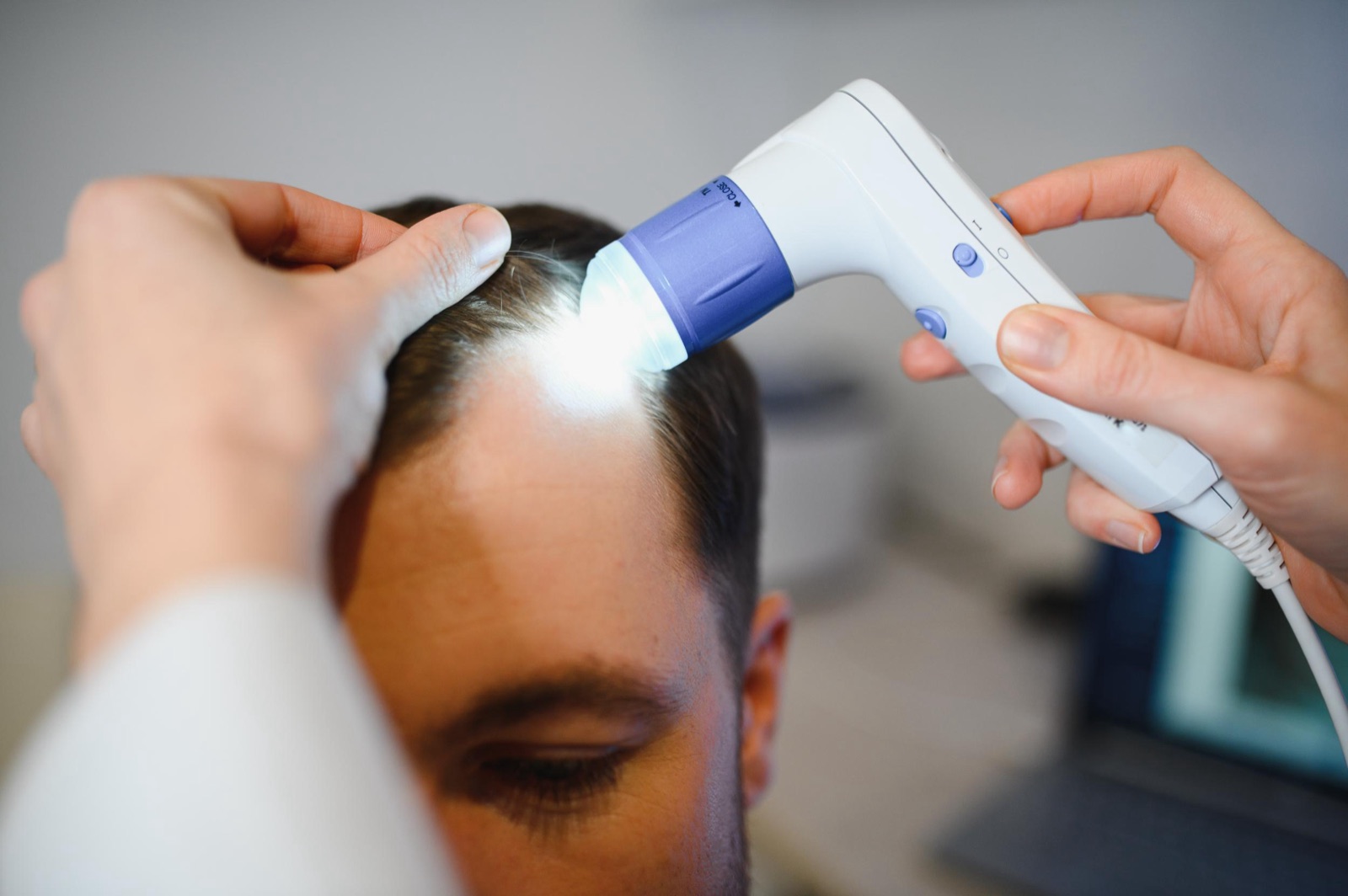
Under magnification, a clinician can distinguish the two: diffuse shedding with uniform hair calibre points one way, while calibre variation between hairs in the same follicular unit points to miniaturization. We also review bloodwork history — iron status and thyroid function are worth confirming with your physician — and the timeline of your medication and weight change.
What treatment can support
For shedding driven by metabolic strain, the primary intervention is nutritional and it happens outside our clinic: adequate protein intake, and micronutrient status confirmed and corrected with your physician.
Alongside that, mesotherapy microinjections are the treatment we most often recommend, because the mechanisms align. Mesotherapy delivers vitamins, amino acids, trace minerals and peptides directly into the dermal layer of the scalp through a grid of fine microinjections — supporting the follicular environment at the moment it is under-resourced.
Where the assessment also identifies an underlying pattern process, we typically add PRP — micro-injections of your own concentrated plasma — and the combined PRP and mesotherapy course becomes the plan. Results vary by individual, and recovery is measured in months rather than weeks, because it is bounded by the hair cycle itself.
A realistic timeline
Shedding from a metabolic trigger commonly runs its course over several months once the trigger settles, with regrowth appearing first as short, fine hairs standing up along the part line. Those are new growth cycles starting, and they are a good sign even though they style badly.
Standardized photographs taken under fixed lighting at the start and at intervals are the only dependable way to judge this. Day-to-day mirror impressions during a shedding episode are almost universally worse than reality.
If you are shedding on a GLP-1 medication and want to know what is actually happening on your scalp, book a consultation at our Toronto, Mississauga or Vaughan clinic. A licensed clinician will assess it properly and tell you which parts are temporary and which need a plan. Finance your plan with Beautifi — 6 months interest-free, instant approval.